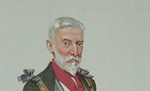
When researching the nobility it is very easy to get into difficulties due to the way in which people are described, In the case of Earl Amherst we have to look carefully at dates to ensure we get the 3rd Earl also known as Viscount Holmesdale before becoming the Earl Amherst. It is further confused by the fact that he was born William Archer!
From our perspective it is his association with Kent that is so interesting. He was initiated in the Westminster and Keystone Lodge No 10 in 1856 and then became a joining member of Invicta Lodge 709 in 1860. He was installed as the Provincial Grand Master of Kent in 1860 (a position he held until 1905) In 1896 he became Deputy Grand Master and in 1898 he was appointed Pro Grand Master (held until 1908)
The Ashford Library Archives have an article from the Kentish Express of 17 March 1877 referring to a meeting for the Consecration of a New Chapter based on the the Invicta Lodge No 709 which took place at the Whitfield Hall. After the Consecration Ceremony Viscount Holmesdale M.P. P.G.M. of Kent was installed as M.E.Z of the new Chapter. Following the ceremony Viscount Holmesdale presided over a banquet held at the Saracens Head Hotel.
The background to this Consecration is documented in the booklet Royal Arch Masonry in Kent by E.Comp Dudley Grasby and in the records of the Invicta Chapter 709 and is fully discussed in the History of the Chapter. (See Links and acknowledgements) In shorter form we learn that the formation of a Royal Arch Chapter in Ashford had been comtemplated for some time but had been deferred pending the building of a Masonic Hall in the town. However in 1876 there were proposals to re-form a Kent Provincial Grand Chapter The existing Kent Chapters were behind this proposition and intended to ask Viscount Holmesdale to be the Grand Superintendant. However he was not a member of a Kent Chapter, and had not been through any of the three chairs so arrangements had to be made to correct this situation. At a regular meeting of Invicta Lodge 709 held on th 5th January 1877 it was resolved to form a Chapter to be attached to the Lodge. Grand Chapter approved their petition on February 7th 1877. On March 14th 1877 the Consecration Meeting took place.
Following the Consecration, Viscount Holmesdale was passed through the three chairs and became M.E.Z. and a few months later he became the Grand Superintendant of the newly re-created Kent Provincial Grand Chapter.
22 years later as The 3rd Earl Amherst he laid the Foundation Stone of Elliott House and 107 years later W.Bro Les Shugrue saw this stone, stopped, took a photograph and asked a question in the ‘Provincial’ and that, as the saying goes, is where we came in!!
William Amherst, 3rd Earl Amherst
From Wikipedia, the free encyclopedia See: http://en.wikipedia.org/wiki/William_Amherst,_3rd_Earl_Amherst
William Archer Amherst, 3rd Earl Amherst (26 March 1836–14 August 1910) was a British peer and Freemason, known as Viscount Holmesdale from 1857 to 1886.
He was born in Mayfair, London, the son of Viscount Holmesdale (later 2nd Earl Amherst) and was baptised on 3 May 1836 in St. George's Church, Hanover Square, London. He was educated at Eton and went on to serve with the Coldstream Guards, rising to the rank of Captain and fighting in the Battle of Balaclava, the Battle of Inkerman (where he was severely wounded) and the Siege of Sevastopol during the Crimean War.
On his return from the Crimea, Holmesdale became MP for West Kent in 1859 and on 27 August 1862, he married Julia Mann (the only daughter of the 5th Earl of Cornwallis) in Linton, Kent.
In 1868 Holmesdale became MP for Mid Kent until 1880 and on the death of his father in 1886, became Earl Amherst. Julia died in 1883 and on 25 April 1889, he married Alice Vaughan, the widow of the 5th Earl of Lisburne in London.
He died in 1910, aged 74, at his home of Montreal Park, near Sevenoaks, Kent as a result of an operation he received three months prior for a throat infection. He was cremated on 16 August 1910 and his ashes buried two days later in nearby Riverhead. Despite having married twice, the earl died childless and his titles passed to his brother, Hugh.